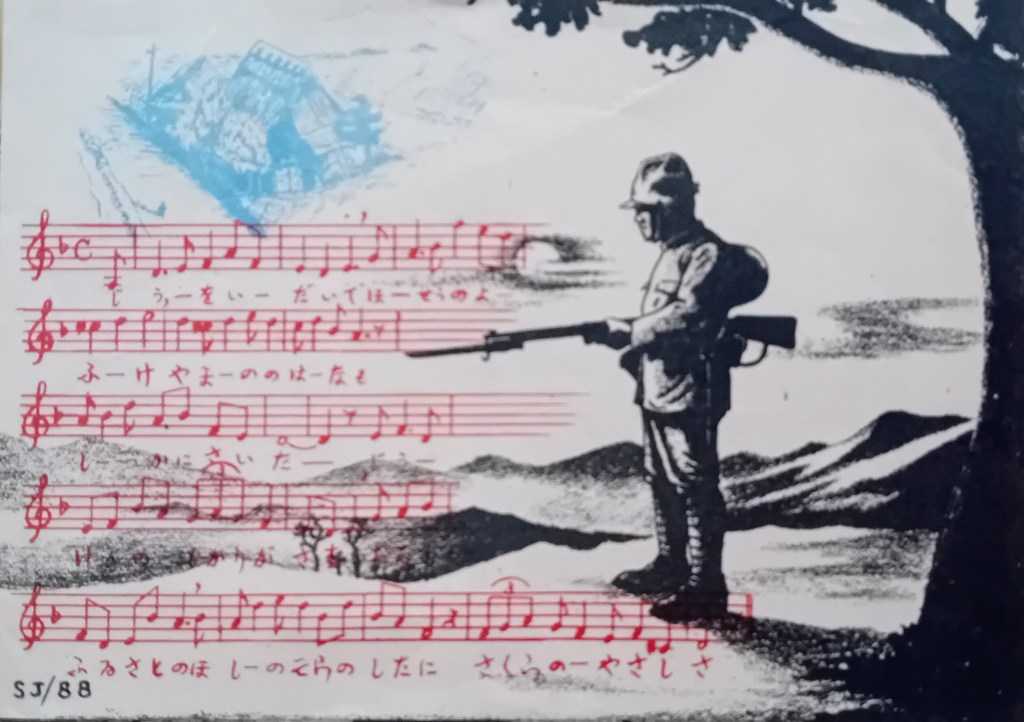
One exciting part of researching Jungle Warrior was going to visit the daughter of Lt.Col. Peacock’s Intelligence Officer, Major Young. Among the many documents, photos and nik-naks he brought home from Burma was the leaflet above.
The SJ/88 in the bottom left tells us it was produced by SEAC, so I assume it was a piece produced by SOE’s Indian Field Broadcasting Units (IFBU), from the political and psychological warfare department of Southeast Asia Command. The units had Korean nationalists seconded to them because they were fluent in Japanese. There were courses at SOAS in London to teach British officers Japanese, but the intricacies of colloquialisms and the nuance of the language was apparently something which could not be taught. The Koreans were therefore tasked not only with producing morale shattering propaganda, but speeches to be played over loud speakers directly over the front lines. Their messages and music were supposed to induce the Japanese to surrender, and as the Battle of Imphal progressed and the Japanese knew they were losing, the IFBUs had some success in this. The means to induce surrender was to make the Japanese feel homesick and nostalgic, hence the image of a traditional Japanese home while the soldier stands guard, alone, far from home…
It struck me that this piece above might be worth translating, having someone analyse the music, and maybe get someone to play it. This has all proved possible through the talented students and staff I work with.
For the musically minded among you, here is the analysis of the notes that I received:
At first glance, it might be said that the key of D harmonic minor is maintained throughout, with C#s added where needed to resolve to the tonic note (except bar 6 – but perhaps we might ignore this as a notation error? After all, like the drawing of the soldier, the notation is done by hand, not engraved). The leading note of C# in bar 4 completes the developing impression that the music will be consistently European in character (In this analysis, bar 1 starts at the first D note, ignoring the anacrusis of note A). It might also be said that typical rhythmic structures of European folk music can be seen to be maintained through the rhythmic form of four 4-bar sections, with long durations at the end of 8-bar sections. Not only are there places in this rhythmic form for breathing, but breathing “commas” are also notated – eg above bar 2. This gives the piece an appropriate song form for the lyrics written below each stave.
However, the music keeps shifting, changing in an unpredictable manner on many levels. The opening phrase of bars 1 and 2 does not reoccur. The large, potentially distinctive under repetition, interval leap in bar 3 is a surprise and does not repeat. Despite the large rhythmic structures mentioned above, the melody constantly changes in contour, stress, etc, and any melodic repetition is relatively weak: e.g. the similar melodic movements from E (beat 2 and) to F (beat 3) in bars 1 and 9. On this basis we hear the piece as through-composed.
Further, by the time we have heard the entire piece, it is realised that a more careful tonal analysis is needed. Expectations set in place by the solid European folk melody found in bars 1 to 4 are modified by the syncopation and limited pentatonic set heard in bars 5 and 6, although this ends on the melodic V of D minor. More syncopation can be found eight bars later at the “answering” bars 13 and 14, but with differing stress and melodic contour. These syncopated sections are clearly formed of the material of local court and folk music: bars 7 and 8, 12 to 14 are built upon the traditional pentatonic Hirajoshi scale (a Japanese mode), using here the notes D, E F, A and Bb. Once announced, this mode is seen to permeate the piece on second performance/reading, with the remaining notes of G and C# appearing as (a) decorative and passing notes, and (b) merely a conventional imported Western leading note, respectively.
Here is a translation of the words:
“Clutching your rifle in the deepening night, even the wild mountain flowers have quietly bloomed. Through the window where the moonlight shines, beneath the starry sky of your hometown, lies the gentleness of the cherry blossoms.”
And here is the music:
We are always told that the Japanese soldiers who fought in WW2 would rather die than surrender, but as I have related elsewhere, at least three white flags were waved by Japanese soldiers during the Battle of Imphal. The IFBUs were therefore considered a success and were requested by divisional commanders when they advanced into Burma. Re-branded Forward Propaganda Units (FPUs), they were on the front line, sustaining casualties, and conducting at least one large and successful operation codenamed BARGE.


Leave a Reply